

Schema Types That Matter for SEO Glory
| Schema Type | Key Attribute | Typical Application |
|---|---|---|
| Article | headline | Your blog posts, news pieces |
| Product | offers | Online shop items, review roundups |
| FAQPage | mainEntity | Those handy Q&A sections |
| LocalBusiness | address/geo | Your shop's location page, service areas |
| VideoObject | contentUrl | Embedded clips, how-tos, trailers |
Level Up Your SEO: Schema Markup & JSON-LD Explained
Your Blueprint for Structured Data Success
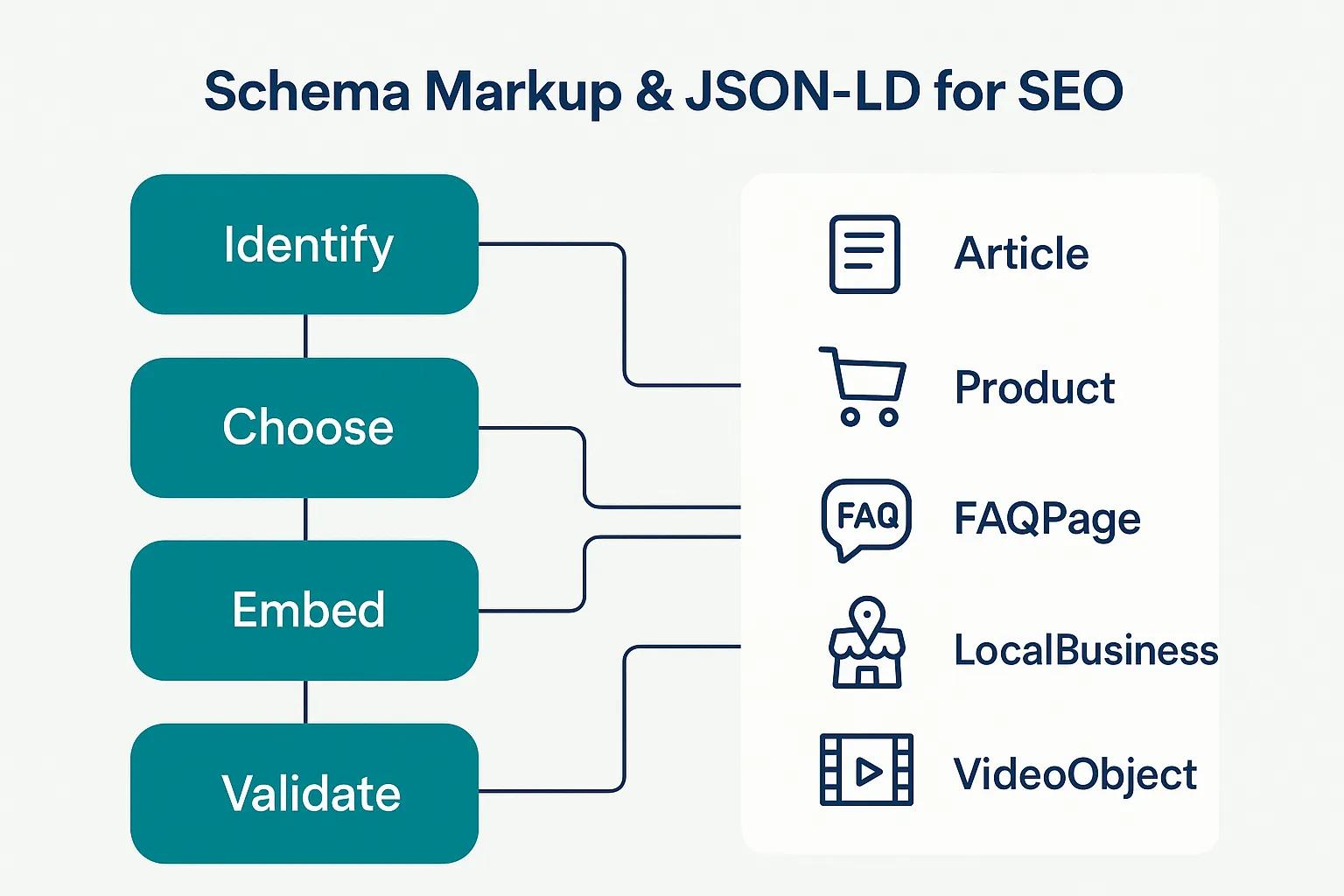
- Pinpoint Your Content – Figure out what kind of stuff you're putting out there – articles, products, events? This helps you pick the right schema.
- Pick the Perfect Schema – Head over to schema.org and find the best fit. Think Article for your blog posts or Product for your shop pages. Make sure it’s a match!
- Weave in JSON-LD – Pop these scripts into your HTML's or . They’re like a clear map for search engines, showing them what’s what.
- Test Your Code – Use tools like Google's Rich Results Test to make sure your structured data is flawless and search engines can actually read it.
- Watch Your Wins – Keep an eye on how your site performs in search. See how structured data is boosting your visibility and click-throughs.
- Keep It Fresh – Update your structured data whenever you add new content or tweak existing pages. Stay current, stay seen.

What's the Scoop on Structured Data and Why It's an SEO Must-Have?
Why All the Fuss About Structured Data in SEO?
Schema.org: Enhancing Search Engine Results and Search Engine Optimization
1. This article describes the main characteristics of Schema.org, the vocabulary developed in 2011 by Google, Bing, Yahoo!, and Yandex to markup webpage content, thereby making data recognizable and understandable to search engines. We present the primary application of Schema.org today, which is to enrich the information about a webpage displayed in a search engine’s results. We then examine the fundamental principles of Schema.org’s structure (classes, properties, values, etc.) and the coding formats it accepts. Furthermore, we explain how to markup webpage content with Schema.org and describe who currently uses, maintains, and develops this vocabulary. Finally, we briefly assess the advantages of using Schema.org, as well as its potential applications in improving searches and search engine results (e.g., greater accuracy, enhanced functionalities); the development of the semantic web; and the area of website ranking (search engine optimization, SEO).
2. The main characteristics of Schema.org, the vocabulary created in 2011 by Google, Bing, Yahoo!, and Yandex to markup webpage content, making its data recognizable and understandable to search engines, are described. Its primary current application, the enrichment of information displayed by search engines for each webpage in their results, is presented, along with the foundations of its structure (entities, properties, values, etc.) and the coding formats it accepts. It also explains how to markup webpage content with Schema.org, who currently uses this vocabulary, and who maintains and develops it. Finally, the advisability of using Schema.org is briefly evaluated, as well as the potential applications of this vocabulary in the improvement of searches and search engine results (more precision, more functionalities, etc.), in the development of the semantic web, and even in the ranking of webpages in search engines.
Schema. org: An enhanced display of search engine results and much more, A Sulé, 2015
How Does Structured Data Give Your Search Visibility and Click-Through Rates a Boost?
What Are Rich Snippets, Knowledge Panels, and Semantic Search?
How Does Structured Data Help You Win at Voice Search?

Which Structured Data Types Are Your SEO Must-Haves?
What Are the Top Schema.org Types for SEO?
| Schema Type | Key Attribute | Typical Application |
|---|---|---|
| Article | headline | Blog posts, news articles |
| Product | offers | E-commerce listings, review aggregations |
| FAQPage | mainEntity | Frequently asked questions sections |
| LocalBusiness | address/geo | Store location pages, service area definitions |
| VideoObject | contentUrl | Embedded trailers, tutorial videos |